


FANTASIES THAT ARE GIVEN HOUSE ROOM
By An Alien Eye
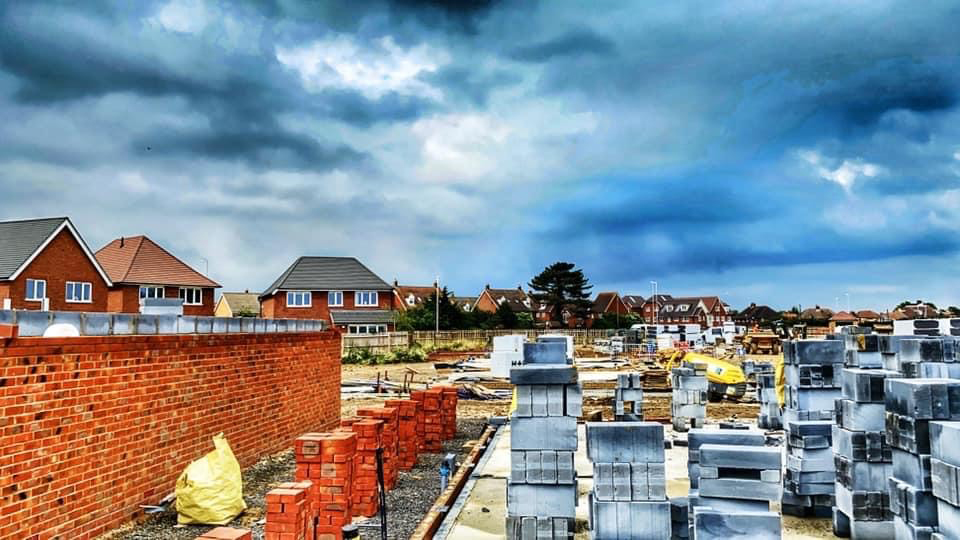
Having seen some online promotional images for the Hopwoods housing development, visualisations typically produced in a 3D program and populated by anodyne photoshopped stock figures, a look that is reminiscent of those Hornby train set dioramas where everything and everyone appears curated to a grand plan, I drive out to beyond Canterbury along the Island Road to where the development is situated across from the less than salubrious mining houses of Hersden. This other long established housing estate, redolent of the austere style of budget council housing of the 1920s and 30s, sits accusingly across from the scheme being built directly opposite from them. This New Hersden in contrast, appears to be an ironic post-modernist statement in that the design process seems to have gone through some kind of time reversal, with the houses and their surroundings resembling a Thomas Hardy theme park simulating a flavour of ideal living recognisable in a hazy cultural memory reinforced through the many chocolate box representations as seen in the pages of magazines such as Living Etc, Beautiful Homes, and HouseBeautiful. And just as with the 3D visualisations of the development on the building contractor’s website, its actual ‘real’ verisimilitude appearance possesses an uncanny over tidiness, as if no real people live here, or that if they do, they have been conditioned such that they have become subordinated extras in a set, their behaviour programmed towards a strict maintenance of a life-style which sees that every blade of grass, flower and every shrub, as well as their own compliant citizenship conforms to a glossy prospectus design for living.

Rather than progressing from the architectural styles of the 1930s to the present day through a modernist revolution in building design in the Spirit of Harold Wilson’s White Heat of Technology, the architects of this development have recalibrated their design clocks so as to travel backwards through the end of the millennia, with sparkling showers of exploding fireworks returning back to their boxes, regressed back through the seismic cultural shifts of the 1980s and 60s, the cataclysm of the second and first world wars, a scene of yet more deadlier explosions now sucked back through the air into their cylindrical shell casings and returned to ordinance factories, and ultimately rewound all the way back to the period before the turn of the twentieth century, in what appears to be a total disavowal of that century’s turbulent history. It is clear from the high pitched roofs, the faux mullioned windows, the delineated wood frame stucco, and the rough cast render finish with simple Arts and Crafts motif stylings, that their choice of historical dress is redolent of the proto or early Garden City movement. Moreover, the landscaping and irregular winding street layout lends to the impression of an organic growth established over time similar to that of a village, not of somewhere that has been industrially designed to a master plan imposed onto the landscape. However, despite the effect put into making this estate appear natural, a naturalness that will in a short time try to insinuate itself as a long-standing settlement in this part of East Kent, it cannot escape looking contrived. That despite this conceit – to blend in in pretending to be part of that golden age of philanthropic house building from the early twentieth century, to disappear as it were in not causing offence to a narrow conception of what proper traditional houses should look like, it is ultimately just a performance by merely appearance, and as such is mimetically trying too hard to be something which it is not.

That these cottagey designs exist is due to a marketing ploy that purports to offer not only somewhere that is a practical living space to support the demands of 21st Century, but has created a reified dream state in that this collection of houses offers a link with a past before the world appeared to have gone out of its mind in discarding what is seen by many to have been time honoured ways of living, ways of living seen in historically myopic memory as being self evidently good. These spectacles to a vision of the past, by their design purport to offer a simpler life – a pastoral idyll set in stone, or rather timber frame and wattle and daub as prescribed by the great reformer and anti-industrialist, William Morris, and through him back to the medieval revivalist Architect, Augustus Pugin who believed that in resetting the design clock back to the Middle Ages, one might recapture the moral virtues of this nobler age, that is before communities had succumbed to the urbane artifices and fake stucco manners ascribed to the malaise of what was perceived as a morally moribund modern age.
Yet in most of the modern housing schemes that offer this idea of a simpler life, one in which it is a safe place to settle down and raise a family in the warm embrace of a wider community, they offer none of the solutions to address these deeper needs people have in finding that place they can call home. There is no equivalent term in English, but in Germany they use the word Heimat to denote the idea of a home that is not just a space situated within the walls of a house, but refers more broadly to a landscape and its peoples bound by a shared system of values. It is this wider place and community being inferred by these designs as home. Indeed, many of the questions of those who’d walked into the sales centre office to express an interest in a property on the development concerned this broader aspect of community. Was there a shop, post office, a pub and community centre? However, the customer advisor at the sales centre informed me that there was no intention of providing these amenities as the development, despite it housing many hundreds of people, was deemed by the contractor as being not sufficiently large enough to warrant such infrastructure. As a consequence, this new development would also be of no discernible benefit for those residing in the long established communities living in the neighbouring estates. What community there had originally been here was decimated after the miner’s strike in the mid 1980s, as the subsequent pit closures fragmented the community, and its shops and social club were collateral victims through the loss of all the jobs in that single industry which had uniquely bound the community together. The resultant outcome was impoverishment on a community-wide scale. With little secure employment and with no social nexus, the usual types of social breakdown have occurred with Hersden classed as an area of deprivation. It seems incongruous therefore that a new development of what are termed by the contractor as Luxury Family Homes should be situated directly opposite such a run down neighbourhood. It could be argued that by placing these many new luxury houses next to this impoverished neighbourhood, it is addressing the issue of social integration in creating a mixed community. However, they are separated by a busy main road, with traffic accelerating at speed from the main roundabout intersection. This produces a barrier similar to an impassable river, one which can only be traversed via only a couple of pedestrian crossing points along this long stretch of road. As such there is very little that physically integrates the two communities. Moreover, why would members of this new community of aspirational professionals with vaunting hopes for their offspring wish to cross to the other side, as there is nothing of any value for them in this deprived neighbourhood. With no amenities, the peoples’ living opposite from them will be an irrelevance as there are no spatial commonalities to produce the conditions to mix. Instead, in keeping with their tastes in buying into a life-style they have chosen by living in pseudo Arts and Crafts houses, these new residents will gravitate towards the centre of Canterbury with its retail parks, supermarkets, shopping malls, department stores, set within the quaint precincts of Canterbury’s inner ring.
Distinction it seems, is at the centre of this development’s conceit, as the prospective buyers of these properties, many coming from as far a field as the London area will have been fed a sense of their own social worth through the subliminal messages in the advertising campaign on the contractor’s website. Desiring to be better people, there is this compulsion to be viewed as such, and these ‘well appointed’ houses are demonstrable of their success. However, the overall effect is to create a distinction between these new inhabitants who are the success stories, and the existing community who by implication, are deemed to have failed. And as entities with these sharp distinctions, instead of creating the conditions for social convergence, it will have the opposite effect in producing social division. It is easy to see therefore that inherent in the relationship between these two quite separate divided communities will be a tension expressed in the form of resentment by those that don’t have for those that do, and that conversely, it will inspire fear in those that do about ‘those others’ over the road from ‘us.’ Therefore, rather than creating an idyl to a past with its associated value of safety of place and home, it will have created ghettos of resentment and fear, fear which for the new prosperous neighbours will be expressed by the installation of additional door and window locks, security cameras, and alarms. Crucially, despite there being initiatives from central and local government to push for the provision of affordable housing with all new housing developments, there is little incentive by local authorities to go through the legal channels in following up promises given by builders to produce these to address the dire housing crisis, and contractors often engage in the sharp practice of redefining what an affordable house actually is, making it unaffordable for the demographic it is supposed to help. Why would they even wish to entertain the prospect where the maximisation of property values is compromised unless that is, there is a multi-agency master plan that forces them to act with a civic conscience. They are after all, private companies. Common to this general trend therefore, there is absolutely no provision for affordable housing in this development as it is pitched at a market of professionals, and as such defines itself as exclusive.

Another deeper issue arises from the appropriation of the Arts and Crafts, Garden City style. That these new developments are utilising merely the appearance of what are clearly traditional, or more precisely neo-traditional designs, as the Arts and Crafts movement were invoking a earlier bucolic past time, they invariably appeal to the tastes of the culturally timid and socially conservative. Yet these designs carry with them the residue of their original ideas which were in their time, revolutionary. This movement came into being as a consequence of the mass industrialisation of this country throughout the 19th century as epitomised in the novel, Hard Times by Charles Dickens which summarised the dreadful conditions urban dwellers lived under. Its corrosive effects on the society and of the psyches of all those who dwelled in the soot blackened Coketown encapsulated the nadir of what progressive reformers were fighting to put an end to. Filthy air and disease ridden slums were key factors that motivated such philanthropic schemes. But it was also a moral crusade which saw that the cities with their physical decrepitude had also fostered a moral decay. That our surroundings can improve us is moot, but it is better to try than not to bother. Perhaps. But this particular vision was infused with a fervour formed around ideas of returning to an UR time long before the modern age of coal, iron and machines. A guide to a future society therefore would be modelled not on the modern technological advances emerging out of the 19th Century, as these were perceived as corrupting, but on an agrarian principle of hand crafts synonymous to the medieval period, a period which ironically for those who lived in them meant that their lives were brutish nasty and short. The design of the garden cities of Letchworth and Welling, and many of those that would follow, slavishly pursued this ancient villagy architectural ethos in the belief that these would change their citizens minds for the better. Betterment however was further encouraged in forms of obligatory communalism, and in this spirit of reverting back to a pre-industrial age, the introduction of hey nonny no folk dancing, singing, hand craft and weaving, as well as other arcane rituals, often reinventing a folkish culture – a collective false memory as it were, was inveigled onto these communities as a form of mind cure. Yet these, as with all Utopian schemes, were ultimately paternalistic, their cultish rules imposed with sanctions for those who did not demonstrate the requisite team spirit. Totalitarianism would ultimately have been the natural extension of cultural determinism, and this is true in continental Europe as the Arts and Crafts ethos of Karl Larson from its naturism to its middle Earth bogusly folklorish cottages were utilised by the Nazis to dress their racial supremacist ideology in.
Utopias are bound to fail as they attempt to simulate a version of Heaven on Earth that is invariably not shared by everyone, and persuasion is often proceeded in beating the detractors into paradise with a stick. Or worse, shooting them. That the Garden City succeeded and didn’t degenerated into some ultra nationalist cult was in major part due to local authorities and private building contractors all around the country recognising their value insofar as putting into action large public housing schemes that took into serious consideration well designed homes and green spaces. And whilst these lent to some degree in their appearance to the Arts and Crafts style and Ebenezer Howard’s Garden City town planning, there was no insistence on the cultish social experiments of their prelapsarian exemplars. Nowadays, in towns and cities throughout the U.K., this style of house construction has become ubiquitous. In no other parts of the rest of Europe will one see such vast building in the fashion of the pseudo vernacular. It is a vehicle by which the English have reinvented around themselves a mythic past such that it seems that an Englishman’s home is his fantasies, for these are domestic spaces that are escapisms on a grand scale from the present, a looking away from the contemporary world of complexity into a vague historicisation that never existed, yet these are still illusions that many would call home, a home with a rocky foundation from which to view the world outside itself. In these days of identity politics, magnified moreover by the Brexit referendum and the UK’s departure from the European economic political block, this idea of Englishness undergirded by all this phantasmagoria of medieval insubstance is nonetheless a potent set of symbols with which political leaders, touting a traditional English sensibility as eulogised in so many reactionary English philosophies, can hook the minds of those millions of people who have immersed themselves in this folkish fairytale. Like words, symbols and the images that support them have implications, and implications have consequences. The consequences of these traditional fake Arts and Crafts houses is, I suspect, a compliance to a social order which repudiates change because, due to it always looking back into the past, it is inherently suspicious of the future, a future where change is hated and even feared.
