


Squeeze Gut Alley

By Whitstable
S
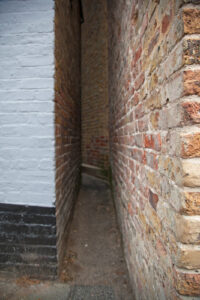
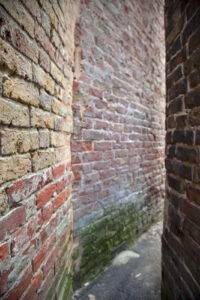
queeze Gut Alley runs between Island Wall and Middle Wall, and it earns its name honestly: the walls close in as you go, and near the far end there is barely room to pass. You turn sideways, breathe in, and squeeze.
It is the narrowest of the alleys threaded through the old part of Whitstable, and the best known. Whitstable Museum measures it at about one foot three inches at the tightest point, widening to roughly two feet at the other end. The local histories give the narrow entry as eighteen and a half inches. Either way, it is not a passage for a wide pushchair or a rucksack worn on the back.
Where it is and how to find it
Walk along Island Wall and look for a house called Squeeze Gut Cottage. The alley is the gap between two houses directly opposite it — easy to walk past if you aren’t looking for it. Follow it through and you come out on Middle Wall.
Coming the other way, from Middle Wall, the approach is stranger. The alley starts light and wide, then narrows between high walls that lean inwards at their tops, until it looks for all the world like a dead end. You turn right, then left, and there is the gap.
It is a public right of way — open at any hour, free, and best taken as part of a slow wander through the alleys rather than hunted down on its own. Half the pleasure is losing the main streets for ten minutes.
The names it has had
The present name needs no explaining; one walk does that. The earlier ones are more interesting.
It was once Feltham Alley, after a house of that name that no longer stands. It was also known as Granny Bell’s Alley — she is remembered as the grandmother of the sixteen children said to have been brought up in a single cottage in nearby Beach Alley, in the family of the Ganns, the Whitstable divers whose skill was known well beyond Kent.
As for how it came by the name everyone uses now, the town has a favourite answer, and it involves a policeman. That one is below, where it belongs.

Was it a smugglers’ escape route?
Almost certainly not in the way the story usually goes. Whitstable’s alleys were the town’s short cuts from the High Street down to the sea, used by everyone — fishermen, children, people carrying things to boats. The Museum’s own historians are clear that no single alley was used specifically by smugglers to dodge the law, though they allow that this one may have been useful, since customs officers pursued on horseback and a horse fits down it about as well as a stout policeman does.
The fuller story of the free trade in Whitstable — including the escaped French prisoners of war run out through the town — is told in Whitstable’s alleys and the smuggling trade.
If you grew up here and knew the alley by another name, or you’ve heard a different version of how it came by this one, we’d love to hear — corrections and memories both make these pages better.