


The Chance

By Whitstable
I
n Whitstable Museum, among the town’s treasures, there is a weathered wooden figurehead: the carved bust of a woman, salt-worn and time-darkened, who once rode the bows of a Whitstable ship. Her survival is one of the most remarkable object-stories the town holds. She came through a shipwreck, then a German bomb, and was salvaged from the wreckage both times. This is how she came home.
Please note: the figurehead is currently off display while it’s being assessed for conservation. Do check with Whitstable Museum before making a special visit to see it.
A Whitstable ship
The Chance was built in 1842 at Sunderland — a brig of 134 tons, later re-rigged as a square-rigger when she was bought down from Chatham in November 1845. From then she was a Whitstable ship, and a Foreman ship. The registered owners were members of the Foreman family — George, William and Hannah Foreman, with Edward Kemp — and her masters over the years were mostly Foremans too: Richard, John and G. Foreman among them. The Foremans were a substantial local family, bound up with the oyster fishery and the town’s seafaring life; one of them, William Foreman, was both a ship-owner and a master butcher. The Chance was one of the working vessels that made Whitstable a port as much as a resort.
Wrecked off Hartlepool — and the crew all saved
On 2 January 1857, the Chance was lost off Hartlepool, on the north-east coast. And here is the part worth pausing on, because it runs against the grain of what you’d expect from a Victorian shipwreck: there was no loss of life. The ship was wrecked, but her crew came through it. It is easy, telling old sea stories, to reach for tragedy — but the record of the Chance is a happier one than that. What was lost was the vessel; what was saved was every hand aboard her, and one carved wooden woman from her bows.
The figurehead on the gable
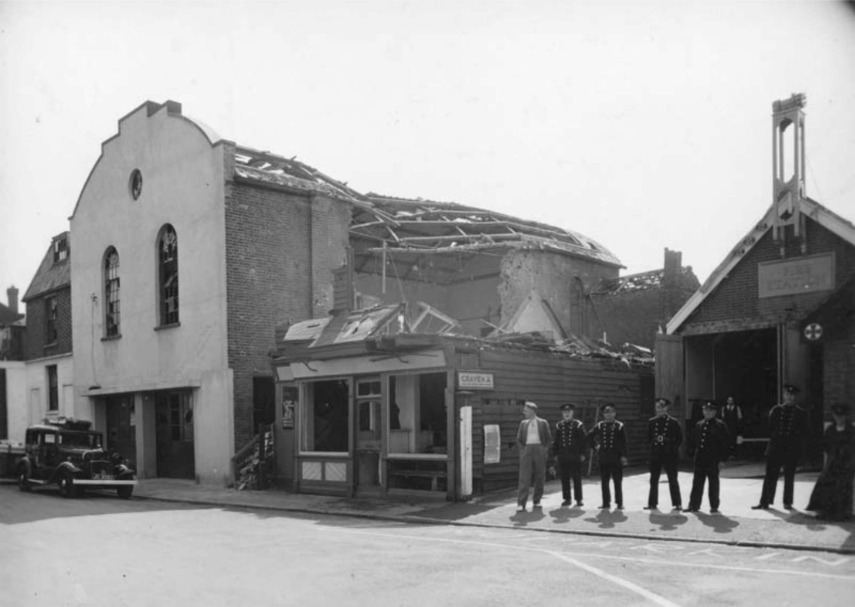
The figurehead was salvaged from the wreck and brought back to Whitstable, and there she began a strange second life. For many years she was fixed to the gable-end of a wooden building in Horsebridge Road, looking out over the street — a ship’s figurehead mounted high on a house, one of those odd, wonderful sights an old sea-town throws up. The same building had an external wooden staircase running down its side, and it was from that staircase, by long custom, that the foreman of the oyster company would call his orders down to the dredgermen gathered in the street below.

She was striking enough that Charles Dickens noticed her. Writing about a “Whitstable Native” in his journal All the Year Round in November 1859, he pictured a local lad so used to the town’s oddities that he’d think nothing of an old figurehead “of Minerva,” swept ashore from some wreck, serving as an ornament on a house — finer, Dickens wrote, than any statue ever hewn from stone. But “Minerva” was the novelist’s romance. Figureheads of that time were rarely goddesses; far more often they were carved as real women — the wife or the sweetheart of the man who had the ship built. The face that gazed down Horsebridge Road for all those years was, in all likelihood, not a Roman goddess at all, but a real woman whose name is now lost — remembered, if at all, only through a passing line of Dickens.
Bombed, and saved again
Her second life ended with the war. On 13 August 1940, in the early raids over Whitstable, the building she adorned was struck by a German bomb. She might easily have been lost for good. But — for the second time in her life — she was salvaged from wreckage, lifted out of the ruins and kept. Today she is safe in Whitstable Museum, where you can go and see her: a figurehead that has outlived a shipwreck, a bombing, and the best part of two centuries, and come home to the town whose ship she led. You can glimpse her here, small and high on that gable — but to stand before her properly, close enough to see the grain of the wood and the wear of two centuries in her face, you’ll have to go to Whitstable Museum, on Oxford Street. She’s there still, gazing out as steadily as she did from the ship’s bows. Stand in front of her, and you’re looking at a survivor of a shipwreck, a bombing, and the best part of two centuries.
If you know more about the Chance, the Foremans, or the building on Horsebridge Road — or who the figurehead might really have been — we’d love to hear. Corrections and memories both make these pages better.