


Copperas, Whitstable’s forgotten industry
By Whitstable
Long before the oyster yawls and the beach huts, Whitstable’s shore fed a very different trade. For over two hundred years, from the reign of Elizabeth I into the age of the railways, the Whitstable and Tankerton beaches supplied the raw material for one of England’s earliest chemical industries — copperas. Almost nothing of it is left to see, yet the mineral is still underfoot if you know where to look, and its name still sits, quietly, on the map.
What was copperas?
Copperas is one of those old words that hides more than it tells. It sounds as though it ought to have something to do with copper — a misunderstanding that lasted for centuries — but copperas has no copper. As found, it is Iron Sulphide (FeS2) commonly known as iron pyrites, a compound of iron and sulphur. The processed chemical is green vitriol: ferrous sulphate (FeSO4) also known as copperas! The confusion is ancient and forgivable; in the days before modern chemistry, “vitriol” was a loose family name for a range of sulphur-bearing substances, and green (iron), blue (copper) and white (zinc) were all lumped together under ‘vitriols’. Copperas is the green one, and it is iron through and through.
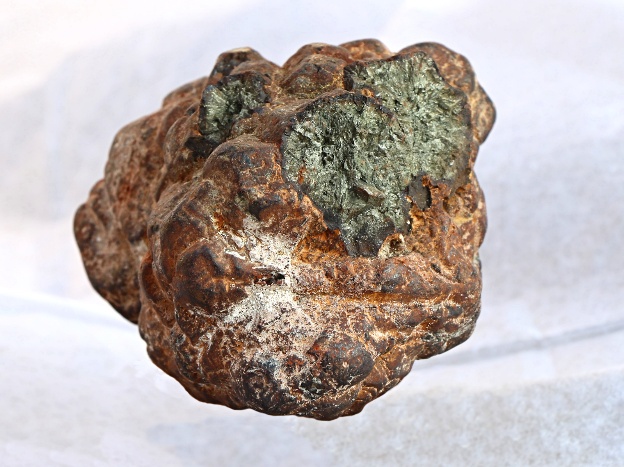
Goldstone variety of copperas
The mineral mattered because of its many uses. Copperas was a mordant that fixed dyes to cloth — especially the blacks worn by both important and common people, and required for mourning. It was central to iron-gall ink, the permanent ink of manuscripts and record-books for centuries. It went into tanning leather, into sheep-dressing, even into the sulphur required for gunpowder. The first pure sulphuric acid came from copperas. In a Tudor economy built on wool and cloth, a home supply of copperas was not a convenience — it was a matter of economic survival as supply was controlled by the papal monopoly which hugely increased costs to protestant England.
Why here
The reason Whitstable had a copperas industry lies in the cliffs and the clay. The London clay beneath this coast holds iron pyrites — fool’s gold — in nodules and in twig-like fossil forms. As the sea eroded the cliffs, it washed copperas nodules out onto the foreshore. Locally they were called goldstones, for their brassy glint, or sulphur stones, for their smell and nature. Remarkably, today you can still find the fossilised wood form along the shingle of The Street at Tankerton and out on the mud.
Gathered by poor people, these stones were the beginning of a slow, smelly, patient process. They were laid in long beds — ‘pannells’ some over a hundred feet long — lined with packed clay and left open to the weather. Over four years, rain and air and a slow bacterial rot broke the stones down into a weak solution of iron sulphate and sulphuric acid. That liquid was drained off, pumped into huge lead boilers over coal furnaces, boiled for weeks with scrap iron, then run into cooling tanks where the green crystals formed — often on bundles of twigs hung down for the purpose. Dried and casked, the purified copperas went by boat to London, up to 100 tons in a year from just one of the six Whitstable works.
It was grim work. The fumes were noxious, and the beds and boilers dangerous. One worker, John Wellard, running the hot liquor into the coolers, slipped in up to his chest; every effort was made to save him, but he died within a day — a small, sharp reminder of the industrial nature of these vanished works.
The works on the Tankerton shore
The industry began in the reign of Elizabeth I. A man named Cornelius Stephenson secured a Crown patent to work copperas from the Whitstable shore in 1565, though the first firm evidence of production here dates to around 1589–92. His early works, and at least one other, stood on ground now lost to the sea — a fact confirmed centuries later when marine erosion at Tankerton exposed lines of old wooden stakes on the foreshore, excavated by the Canterbury Archaeological Trust and found to be the remains of copperas beds.
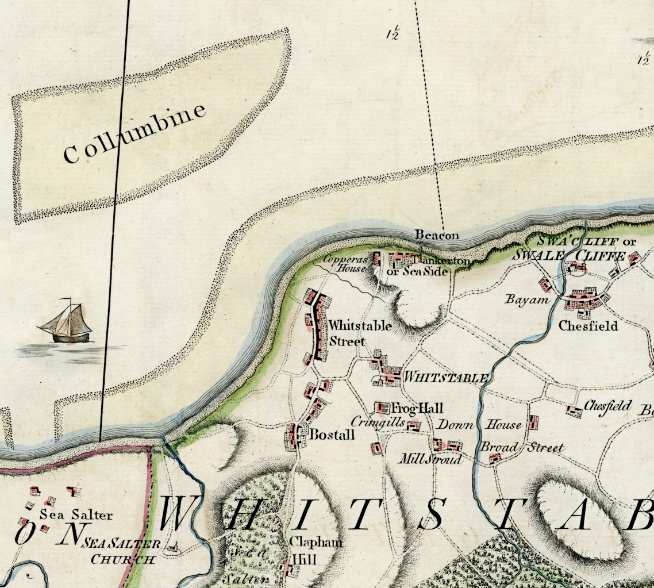
Because the sea was forever taking ground, later works were built on firmer, higher land. Through the seventeenth century a small industrial quarter grew up along what is now the Tankerton seafront — eventually amounting to six copperas ‘houses’. Two local men run through the story: Thomas Gold and Edmund Rouse, partners and copperas entrepreneurs who prospered by the trade, shipped it to London in their own vessels, and ended their days as men of standing in Canterbury. Rouse lived along the coast road at Swalecliffe, in the timbered house later known as the Black Cottages.
The stones themselves belonged, by manorial right, to the Archbishop or the Lord of the Manor who leased out the collecting. The gathering was done by “pickers” — the poor of the town, children among them, who were paid by the bushel. One woman, giving evidence in 1639 at the age of sixty, said she had been gathering copperas from the beach for some fifty years.
Elizabeth Radford inherited three copperas houses in 1773 and managed the industry until marrying Charles Pearson in 1780 who also owned local copperas works. His main income was from the hosiery trade in London, which naturally required dyes and mordants. Income from copperas and textiles funded the building of Tankerton Tower, which grew over the years into ‘Whitstable Castle’.
What’s left today
The copperas industry died as it had lived — at the mercy of the sea and the price of coal. The works nearest the shore were battered by storms, most dramatically the great storm of New Year’s Day 1779, which forced the building of a new sea wall and left some works abandoned. By the 1830s a guidebook could describe only a few ruined buildings. The trade had drifted to the northern coalfields, and Whitstable turned to oysters and the sea.
But the industry is still written into the town if you can read the signs. Sea Wall and Tankerton Road behind the harbour are the new sea wall of 1779 from the Horsebridge to the sites of the copperas works. The old works map onto places you’ll recognise: the Outlets, near where the swimming pool now stands; the Mendfield works where the Almshouses were later built; the Mascall works up by the Tea Gardens and the bowling green, where a copperas bed was actually turned up in the twentieth century; and the “Upper House” on the higher ground opposite the drive to the Castle, where the ground’s odd, hummocky shape may be the works themselves, absorbed into a garden. And down on the beach, the goldstones and fossilised wood still come out of the clay, as they have for hundreds of years.
If you’ve turned one up on the beach without knowing what it was, you do now.
If you know more about the copperas works — an old photograph, a family story, a stone on a mantelpiece — we’d love to hear. Corrections and memories both make these pages better.