


Whitstable Sea Forts

By Whitstable
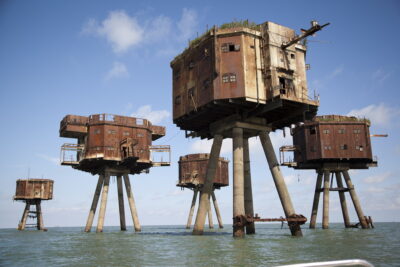
Out in the Thames Estuary, on the horizon off Whitstable, stand some of the strangest relics of the Second World War: the Maunsell sea forts — clusters of rusting towers on stilts, rising straight out of the water. Built to defend London from air attack, later home to pirate radio and a string of film crews, they have stood abandoned for decades, and they remain one of the most haunting sights on this coast.
(Copyright ©Stephen Fisher)
Why the sea forts were built
The Port of London was one of the busiest in the world, and through the war it was one of the few places still able to receive the ships and supplies that kept Britain going. That made the Thames Estuary — the shipping channel you can see from Whitstable — a target. German aircraft mined it heavily, and by 1940 more than a hundred ships had been sunk there. Something had to be done.
The answer came from the civil engineer Guy Maunsell, who proposed fortified towers built offshore on concrete bases, carrying anti-aircraft guns out into the estuary. His designs were approved, and the forts were built on land and floated out to their positions between 1942 and 1943. There were two kinds. The navy forts — Rough Sands, Sunk Head, Tongue Sands and Knock John — were large single structures. The army forts, which are the ones visible from Whitstable, were stranger and more striking: each was a cluster of seven towers on legs — six gun and accommodation towers around a central control tower, all linked by walkways. Three army forts stood in the Thames Estuary: the Nore, nearest the shore off Sheerness, and the Red Sands and Shivering Sands forts further out.
The forts at war
Armed with heavy anti-aircraft guns, Bofors guns and searchlights, the forts did their job. Between them, the Thames estuary forts are credited with shooting down 22 enemy aircraft and around 30 V-1 flying bombs — no small contribution to the defence of London. Life on them was bleak: crews of servicemen lived out on the exposed towers, miles from land, in cramped quarters battered by the wind and the sea.
Abandoned — and the loss of the Nore fort
After the war the forts stayed manned for a while, but by the late 1950s the War Office decided they had no further use, and they were stripped of their machinery and left. Two of the three Thames army forts still stand — Red Sands and Shivering Sands. The third, the Nore, did not survive: already weakened by storms, it was struck by a passing ship and was dismantled between 1959 and 1960. It was not the only such collision — in 1963 a vessel struck one of the Shivering Sands towers and knocked it into the sea, though happily without loss of life. Their entry ladders sawn off to deter trespassers, the surviving forts began their long, slow rusting.
Pirate radio on the sea forts
Empty, isolated and beyond the easy reach of the law, the forts found a new use. In the mid-1960s, at the height of the pirate radio boom, the broadcasters moved in. On Shivering Sands, Screaming Lord Sutch launched Radio Sutch in 1964; it was soon taken over and renamed Radio City by Reginald Calvert. On Red Sands came a succession of stations — Radio Invicta, then KING Radio, then the more successful Radio 390, which found its audience with a format aimed at housewives. The pirate era ended in both drama and law: Calvert was shot dead in 1966 after a dispute connected with the stations, and the Marine Broadcasting Offences Act of 1967 finally silenced the offshore broadcasters. (The modern Red Sands Radio, which has broadcast from the fort under licence since the 2000s, is a later and quite separate revival.)

The sea forts on screen — and in fiction
For such remote structures, the forts have had a remarkable screen career. Red Sands stood in as an offshore rig in the 1968 Doctor Who serial “Fury from the Deep” (now, sadly, one of the series’ lost episodes), and it featured in the 1960s spy series Danger Man. The pirate-radio drama fed straight into film: Slade’s 1975 musical Flame recreated a fort broadcast, complete with a staged attack from a ship. More recently the forts have appeared in The Hunger Games: Catching Fire and Artemis Fowl, and in music videos by U2 and the Mystery Jets. They even sit at the heart of a Whitstable story — Julie Wassmer’s crime novel Whitstable Pearl.
Project Redsand, and the forts today
Red Sands is now looked after by Project Redsand, a volunteer group working to preserve the towers and their history, with hopes of opening them more fully to the public in time. Occasional licensed broadcasts have gone out from the fort to mark its heritage. But make no mistake: the towers are fragile, rusting and genuinely dangerous, and there is no public landing.
Can you visit the Whitstable sea forts?
You can’t set foot on them — but you can get close, and it’s well worth it. Several operators run boat trips out to the forts. The Thames sailing barge Greta runs day trips from Whitstable harbour itself, and X-Pilot sails out from Queenborough on the Isle of Sheppey. The forts lie a good distance offshore — an hour or more out — so a trip makes a proper day of it, often taking in the wreck of the SS Richard Montgomery and the estuary wildlife along the way. Seen up close, rising sheer and silent from the water, they are unforgettable.
If you’ve been out to the forts, or you know more about their history, we’d love to hear.