Whitstable oysters and the Romans

By Whitstable
Ask anyone in Whitstable about the town’s oysters and you’ll hear, sooner or later, that the Romans loved them so much they shipped them back to Rome. It’s a lovely line, printed in guidebook after guidebook. The truth is more tangled, and — once you follow it out onto the seabed — rather more interesting.
What the Romans really thought of British oysters
The Romans were serious about oysters, and they thought British ones were among the best in the world. The clearest proof is a joke. In one of his satires, the poet Juvenal mocks a court gourmet so expert that he could tell at the first bite whether an oyster had come from Circeii, from the Lucrine Lake near Naples, or from a British bed — putting our native oysters in the same breath as Italy’s most prized. That a Roman writer could expect his readers to get the joke tells you British oysters had a real reputation at the heart of the Empire.
But look closely at the word Juvenal uses. The British oysters he names are “Rutupian” — from Rutupiae, the great Roman port at Richborough in east Kent, the gateway through which almost everything entered Roman Britain. And here is the catch: Roman writers used “Rutupian” loosely, as a byword for British oysters wherever they were actually gathered, much as they called the whole island “the Rutupian shore.” Some scholars have even doubted Richborough was much of an oyster ground at all, though its excavations have turned up oyster shells in quantity. So “Rutupian oyster” was really a label for British oysters under the name of the port they passed through — not a postmark for any single bed.
So did Whitstable’s oysters go to Rome?
Almost certainly not in the way the story is usually told. There is no evidence tying the town’s own beds to a trade with Rome, and the local historians who know this coast best have long treated the “Whitstable oysters to Rome” line as a guidebook flourish rather than a fact.
What is true is quieter and better founded. There was an oyster fishery along this coast in Roman times — the great Roman city of Canterbury, only a few miles inland, has yielded oyster shells in abundance from its dig sites, and the sheltered local waters would surely have been worked to supply it.
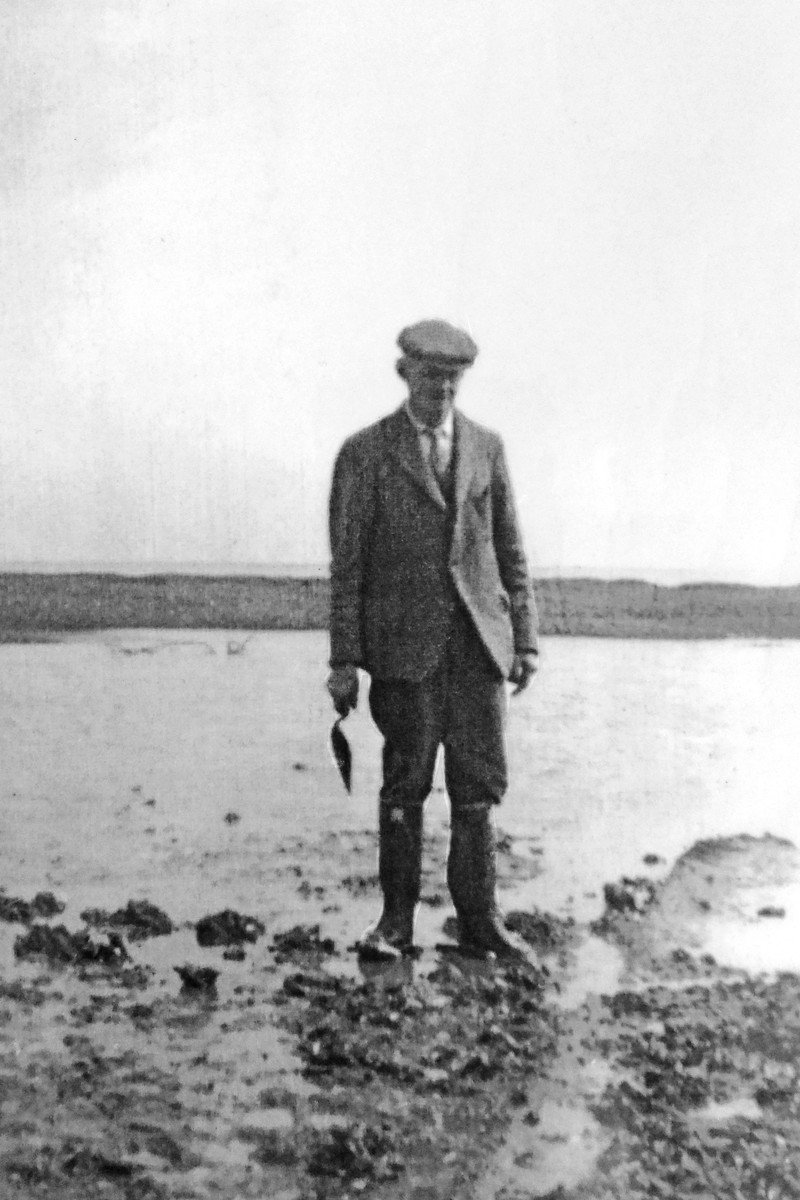
The hard evidence is homely rather than imperial. In 1970, at an exceptionally low tide, T. E. Porter found the remains of an oak dug-out boat in the mud off the Seasalter shore — nearly nineteen feet of it, lying where it had settled, its sides long since eroded away. Sixteen years later a sample of that oak went to the Oxford radiocarbon laboratory, and the result placed the timber between AD 210 and 400: the span of the Roman occupation of Britain, with a third- or fourth-century boat the likeliest reading.

It is worth being exact about what that date does and doesn’t tell us, because it is the kind of thing that gets rounded off in the retelling. Radiocarbon dates the wood, not the boat. It says when the oak was alive — not when someone felled it, hollowed it out, or pushed it onto these flats. The boat is Roman-period; the precise year it was made is not something the science can give us.
Not a galley bound for Rome, then, but a working boat, from the hands of the people who actually fished these flats while the Romans were here.
The drowned Roman coast
To picture any of this you have to unpicture the shoreline you know. In Roman times the coast lay perhaps two and a half to three miles further out than it does today. The land here has slowly sunk — by something like fifteen feet since Roman times — as the whole eastern side of Britain tilts gently down into the sea. What are now the Kentish Flats, covered by shallow water, were once dry ground; at a freak low tide in 1896, people walked out over the exposed seabed and found the fallen trunks of a drowned forest, and lumps of ancient waterlogged wood still wash up on the beach.
Somewhere out beyond that lost land, in the water that covered it even then, lies the town’s strangest Roman relic. For centuries, fishermen dredging the flats around a shoal called Pudding Pan Rock brought up Roman pottery — plain reddish Samian tableware, whole dishes among it. So many came up, and in such good order, that Whitstable families used them as everyday crockery; there was even a tradition of baking a rich Ash Wednesday pie in a Roman dish dredged from the sea. The pottery has been traced to the great works at Lezoux in central Gaul and dated to around AD 170 — most likely the cargo of a Roman merchant ship that foundered on the shoal while trading up the Thames toward London. Hundreds of vessels have come ashore over the years. A large local collection was eventually divided between the British Museum and the town’s own museum.
So the Romans and the Whitstable oyster is a true story after all — just not the one on the postcard. The town’s waters were fished in Roman times, its seabed holds a Roman wreck, and Britain’s oysters really did delight the Empire’s finest palates. The single detail that doesn’t hold up is the one everyone repeats: that the oysters in question were Whitstable’s, sent to Rome. The real history needs no embroidering.
If you know more — a Pudding Pan pot in the family, a Roman find along this shore — we’d love to hear. Corrections and memories both make these pages better.